Job: The Ultimate Test of Faith
Suffering, silence, faith,and the God who sees beyond what we can understand
There are moments in life when suffering does not arrive with an explanation. It does not knock politely. It does not give us time to prepare. It comes suddenly, violently, and sometimes without any visible reason.
The story of Job is one of the deepest books in the Bible because it speaks to this mystery. Job was not suffering because he was wicked. He was not being punished for a secret rebellion. The Bible describes him as a man who feared God and turned away from evil.
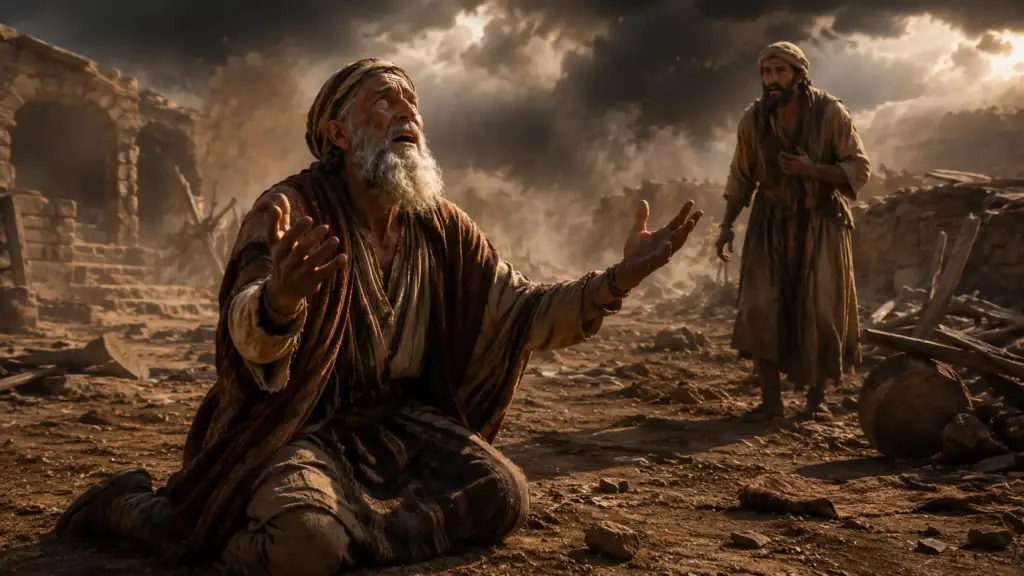
And yet, everything around him collapsed. He lost his possessions. He lost his children. He lost his health. He sat in ashes, covered in pain, while the life he once knew disappeared before his eyes.
Job’s story teaches us something many believers must eventually learn: suffering is not always a sign that God has abandoned us.
Sometimes the righteous suffer. Sometimes the faithful cry. Sometimes those who love God walk through seasons they cannot explain.
The Righteous Can Suffer
One of the mistakes people often make is assuming that pain always means guilt. Job’s friends made this mistake. They looked at his suffering and concluded that he must have done something wrong.
Their logic was simple: if Job was suffering, Job must have sinned.
But the book of Job challenges that easy answer.
Job’s pain was real, but his suffering was not proof that God had rejected him. His wounds were visible, but the spiritual reality behind his trial was much deeper than his friends understood.
This is important for every believer. We must be careful not to judge someone’s spiritual condition by the difficulty of their season. A person can be in pain and still be loved by God. A person can be in ashes and still be under the eyes of heaven.
The presence of suffering does not mean the absence of God.
The Silence of God
One of the hardest parts of Job’s story is not only what he lost, but what he could not hear.
Job cried out. He questioned. He wrestled. He wanted an answer from God. But for a long time, heaven seemed silent.
Many believers know this place. It is the place where prayers feel heavy. The place where the heart asks, “Lord, where are You?” The place where faith continues, but understanding disappears.
Job did not understand the full picture. He did not know what was happening beyond what his eyes could see. He only knew the pain in front of him.
This is where faith becomes more than words.
Faith is not only believing when life is peaceful. Faith is also clinging to God when life makes no sense.
The Danger of Easy Explanations
Job’s friends spoke many words, but much of what they said wounded him more deeply.
They tried to explain what they did not understand. They turned suffering into a formula. They acted as if every tragedy could be solved by a simple accusation.
But human explanations can become cruel when they ignore mercy.
Sometimes people speak too quickly around suffering. They try to fix grief with theology, silence pain with advice, or explain mystery with judgment. But Job shows us that not every wound needs an explanation first. Sometimes what is needed first is compassion.
There is a time to speak, but there is also a time to sit quietly with those who suffer.
God Speaks from the Whirlwind
When God finally answers Job, He does not give Job a small explanation. He speaks from the whirlwind.
God points Job to creation, to the foundations of the earth, to the sea, to the stars, to creatures beyond human control. God reminds Job that there is a wisdom higher than human understanding.
This answer is not cold. It is holy.
God does not tell Job that his pain was imaginary. He does not dismiss Job’s grief. But He lifts Job’s eyes beyond the limits of his own understanding.
Job wanted answers. God gave him something greater: a revelation of Himself.
There are seasons when we ask God for an explanation, but what we need most is His presence. We want the reason, but God gives us the reminder: He is still sovereign. He still sees. He still rules. He still holds what we cannot hold.
Humbled, But Not Abandoned
After God speaks, Job is humbled. He realizes that he had spoken of things too wonderful for him to fully understand.
This does not mean Job’s suffering was meaningless. It means Job finally saw that his understanding was limited, but God’s wisdom was not.
The believer does not need to understand everything in order to trust God. We are not called to carry the universe. We are called to trust the One who does.
Job’s humility was not defeat. It was surrender.
He had lost much, but he had not lost God.
Restoration and Trust
At the end of Job’s story, God restores him. But the restoration does not erase the seriousness of what he endured. The losses were real. The grief was real. The ashes were real.
Still, God was faithful.
Job’s story does not teach us that every suffering will be explained immediately. It does not teach us that pain is easy. It teaches us that God is present even when life is unbearable, and that His wisdom reaches beyond the visible moment.
The God who speaks from the whirlwind is not absent from the ashes.
He sees the sufferer.
He hears the cry.
He knows what others cannot understand.
He remains holy, sovereign, and near.
A Word for the One Who Is Suffering
If you are suffering today, Job’s story is not here to shame you. It is not here to tell you to pretend you are fine. Job cried. Job questioned. Job grieved deeply.
But Job did not let go of God.
You may not understand the season you are in. You may not have answers yet. You may feel surrounded by silence. But your pain is not proof that God has left you.
Hold on.
The same God who spoke from the whirlwind still speaks. The same God who saw Job in the ashes sees you. The same God who restored what was broken still knows how to bring life, healing, and purpose out of suffering.
You may be in the ashes now, but the ashes are not the end of the story.

The Song: Kadosh
“Kadosh” is a solemn Job-inspired worship ballad about faith that refuses to curse God in the middle of loss, silence, and suffering. Through ashes, grief, and unanswered questions, the song declares that God remains holy — not only in blessing, but also in the storm, the furnace, and the mystery.
[Intro]
Kadosh…
Kadosh…
Holy is Your name.
[Verse 1]
He walked beneath a sky of favor,
with oil upon his door.
Children’s voices filled the morning,
servants crossed his floor.
Cattle moved like thunder,
fields were dressed in grain.
Every dawn arrived with mercy,
every night returned with praise.
[Pre-Chorus]
Then the day broke open,
not slowly, not with warning.
One man came from the fields
with death behind his mourning.
[Chorus]
Kadosh, Kadosh,
still holy You remain.
Though dust devours my body,
though loss becomes my name.
Kadosh, Kadosh,
I will not let You go.
Your silence is a furnace,
but my faith is not for show.
I do not see the court above.
I do not know the hidden war.
But I will not curse the Holy One.
Kadosh forevermore.
[Verse 2]
“The oxen have been taken.
The servants have been slain.”
Before his breath had settled,
another carried flame.
“Fire fell from heaven.
The sheep are gone.”
Then camels, then swords,
then all he leaned upon.
And last came the silence
inside a messenger’s eyes:
“The house fell on your children.
None of them survived.”
[Pre-Chorus]
He tore the robe of honor.
He fell into the ground.
The dust received his body,
but worship still came out.
[Chorus]
Kadosh, Kadosh,
still holy You remain.
Though dust devours my body,
though loss becomes my name.
Kadosh, Kadosh,
I will not let You go.
Your silence is a furnace,
but my faith is not for show.
[Bridge]
He never saw the council.
He never heard the claim.
The Accuser stood before the throne
and spoke against his name.
Then skin became his prison.
His body turned to grief.
He sat among the ashes,
with dust beneath his knees.
Voices leaned beside him,
soft venom in the ear:
“Curse God. End this loyalty.
What kind of love leaves you here?”
[Breakdown]
Not cattle.
Not houses.
Not servants.
Not land.
Not children he still wept for.
Not health in his hand.
God before the blessing.
God when blessing is gone.
God inside the silence.
God before the dawn.
[Final Verse]
Then the storm began to speak,
and the Holy One drew near.
The whirlwind opened like a throne,
and the earth remembered fear.
Job placed his hand upon his mouth.
His questions lost their flame.
Not because the pain was nothing,
but because the Holy came.
[Final Chorus]
Kadosh, Kadosh,
still holy You remain.
Over dust and over silence,
over sorrow, skin, and flame.
Kadosh, Kadosh,
I have heard and now I see.
The storm was not Your absence.
The whirlwind carried Thee.
I will not curse the Holy One.
I will not turn away.
Kadosh forevermore.
Kadosh beyond the grave.
[Outro]
Kadosh in the ruin.
Kadosh in the flame.
Kadosh in the silence.
Holy is Your name.