The Ten Plagues of Egypt — God’s Power, Justice, and Redemption
The Ten Plagues of Egypt stand among the most dramatic demonstrations of God’s authority in all of Scripture. Found in Exodus 7–12, these events reveal far more than supernatural judgments; they uncover God’s heart for justice, His faithfulness to His covenant people, and His determination to expose and overthrow the false gods of Egypt. Each plague carried spiritual, theological, and historical meaning—declaring the supremacy of Yahweh (Adonai) over every earthly power
1. A Battle of Kingdoms
Before the plagues begin, Moses and Aaron confront Pharaoh with a simple divine message:
“Let My people go.” (Ex. 5:1)
This was not merely a political request—it was a spiritual confrontation between the God of Israel and the oppressive system that held His people in bondage. The plagues served three purposes:
To judge Egypt’s cruelty toward Israel.
To reveal God’s glory to Israel, Egypt, and the nations.
To compel Pharaoh to release Israel, fulfilling God’s covenant promise to Abraham.
Every plague targeted aspects of Egyptian life, economy, religion, and even the pantheon of Egyptian gods. What seemed like natural disasters were actually precise acts of divine justice.
2. The Ten Plagues and Their Meaning
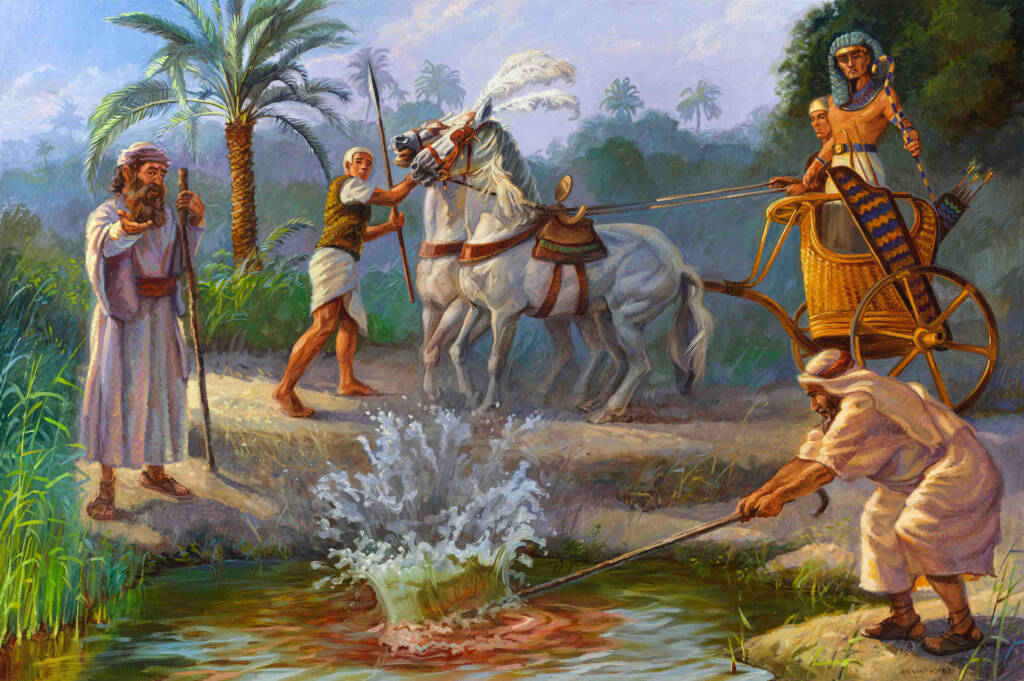
1. Water Turned to Blood (Exodus 7:14–25)
The Nile—Egypt’s lifeline—became blood.
This struck at Hapi, their river god. It showed that the God of Israel had power over the source of Egypt’s prosperity and survival.
2. Frogs (Exodus 8:1–15)
Frogs covered the land, entering homes and beds.
This judged Heqet, the goddess of fertility often depicted as a frog. What Egypt worshiped became a curse.
3. Gnats or Lice (Exodus 8:16–19)
Dust becomes insects, covering people and animals.
Even Pharaoh’s magicians confessed,
“This is the finger of God.”
It exposed their spiritual impotence.
4. Swarms of Flies (Exodus 8:20–32)
Massive swarms spread corruption and filth—yet Goshen, where God’s people lived, was untouched.
This introduced a new truth: God distinguishes His people, protecting them amid judgment.
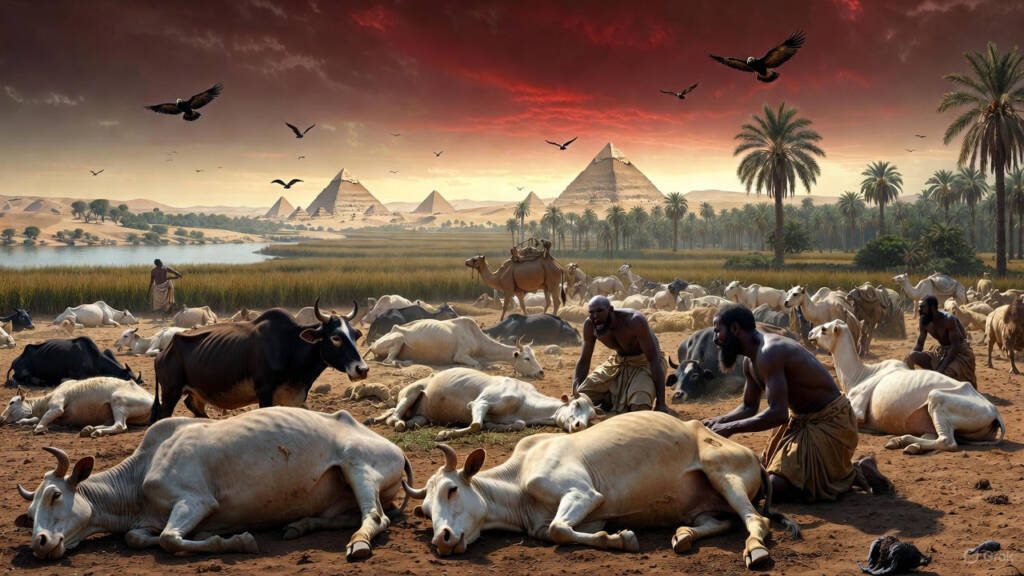
5. Death of Livestock (Exodus 9:1–7)
Cattle—the backbone of Egyptian agriculture—died.
This targeted gods such as Apis and Hathor, believed to protect livestock. Again, Israel’s animals were spared.
6. Boils (Exodus 9:8–12)
Painful sores afflicted all Egyptians, including Pharaoh’s magicians.
This humiliated their healing gods and exposed human frailty without God’s mercy.
7. Hail and Fire (Exodus 9:13–35)
A catastrophic storm destroyed crops, trees, and unprotected people and animals.
It revealed that God commands the elements, and it invited Egyptians to heed the warning:
“Bring your servants and livestock indoors to avoid death.”
Some obeyed, showing that even Egyptians could respond to God’s word.
8. Locusts (Exodus 10:1–20)
Whatever survived the hail was consumed by locusts.
Egypt’s agricultural pride was swept away—total desolation.
9. Darkness for Three Days (Exodus 10:21–29)
A thick darkness covered Egypt, while Israel enjoyed light.
This was a direct judgment on Ra, the sun god and symbol of Pharaoh’s divine power.
God revealed Himself as Lord of light and darkness.
10. Death of the Firstborn (Exodus 11–12)
This final plague broke Egypt.
At midnight, the firstborn of every Egyptian household died.
Yet Israel was spared through the Passover lamb, whose blood on the doorposts marked God’s people for protection.
This plague was both a judgment and a prophecy pointing forward to Jesus Christ, the true Passover Lamb whose blood saves from death.
The Purpose Behind the Plagues
These judgments were not random tragedies—they were carefully orchestrated revelations of God’s sovereignty.
• To Demonstrate God’s Supreme Authority
Every plague dismantled a specific Egyptian deity, proving that Yahweh alone is God.
• To Deliver His People
Israel had suffered for centuries. The plagues showed that God hears the cries of the oppressed and acts with decisive justice.
• To Harden and Reveal Pharaoh’s Heart
Pharaoh repeatedly hardened his own heart—yet God also strengthened that hardness to reveal the condition of a ruler who resisted divine truth.
• To Foreshadow Salvation Through the Blood of Christ
The tenth plague gives us the Passover—an unbreakable shadow of the Gospel.
Just as Israel was saved from death by the lamb’s blood, believers today are saved by the sacrificial blood of Jesus Christ, the Lamb of God.
A Message for Today
The story of the Ten Plagues is far more than an ancient account—it is a living testimony of God’s nature.
God still confronts oppression.
Wherever injustice chains people, the Lord rises to defend the vulnerable.
God still breaks false gods.
Anything we elevate—wealth, power, idols—crumbles before His holiness.
God still distinguishes His people.
Even when judgment or chaos hits the world, those who trust in Him walk under His protection.
God still uses deliverance to reveal His glory.
The Exodus became the defining salvation event of the Old Testament—just as the Cross and Resurrection are the defining events of the New.
The Ten Plagues of Egypt reveal a God who is just, powerful, merciful, and actively involved in history. They point to His ultimate plan of redemption fulfilled in Jesus Christ, the true Deliverer, who sets His people free—not from Pharaoh, but from sin and death.

The Song: Let My People Go
“Let My People Go” is an epic worship-story song that brings to life the unforgettable moment when God rose in power to free His people from Egypt’s chains. Through vivid imagery and cinematic emotion, the song walks the listener through each of the Ten Plagues—the river turning to blood, the swarms, the darkness, the devastation, and finally the midnight judgment that broke Pharaoh’s pride.
Verse 1 — The Cry of the Oppressed
In the darkness of Egypt, a whisper became a roar,
The tears of the children rose higher than before.
Under the lash of bondage, their voices reached the throne,
And God remembered Israel—His covenant, His own.
Pre-Chorus
Then He spoke to a shepherd, with fire in His hand:
“Go tell Pharaoh boldly, by My command—”
Chorus
“Let My people go!
Break the chains of sorrow!
I am the Lord of Heaven,
I rule the night and tomorrow.
My judgments shake the nations,
My power they will know—
For I am God Almighty…
Let My people go!”
Verse 2 — The Plagues Begin
The river turned to blood, the lifeline struck with dread,
Frogs swarmed through the temples and into every bed.
The dust became the gnats, the flies darkened the sky,
And Egypt saw the warning—but still they dared defy.
Pre-Chorus
Moses raised his staff again, by the word of the Living Flame,
“Pharaoh, hear the voice of God, before worse judgments came…”
Chorus
“Let My people go!
Break the chains of sorrow!
I am the Lord of Heaven,
I rule the night and tomorrow.
My judgments shake the nations,
My power they will know—
For I am God Almighty…
Let My people go!”
Verse 3 — Heavy Judgment
The livestock fell in silence, the boils burned the land,
Then hail and fire thundered at the lifting of God’s hand.
The locusts ate the harvest, the darkness stopped the day,
Yet Pharaoh’s heart grew harder—still he turned away.
Bridge — The Final Blow
At midnight came the judgment no mortal could withstand,
The firstborn cried in sorrow across the ancient sand.
But Israel found their refuge beneath the blood-stained door,
And God led forth His people—slaves no more, no more!
Final Chorus — Victory and Freedom
“Let My people go!
Break the chains of sorrow!
I am the Lord of Heaven,
I rule the night and tomorrow.
By mercy and by power,
By signs the world must know—
I am the God who saves you…
Let My people go!”
Outro
With staff and cloud before them, and Egypt left behind,
The Lord of Hosts delivered what His covenant designed.
Justice shook the kingdom, and freedom filled the road—
For God has spoken forever:
“Let My people go.”