Mary of Bethany and the alabaster jar: when worship gives everything
Some acts of worship are silent; others are public and costly. Some become remembered forever.
The anointing of Jesus by Mary of Bethany is one of the most moving scenes in the Gospels. It embodies love, sacrifice, prophecy, and worship. A woman offers her most precious possession to honor the Savior before his death.
To understand this moment we must consider who Mary was, what her alabaster jar represented, and what her gesture teaches us about true worship.
Mary of Bethany at the feet of Jesus
Mary was the sister of Martha and Lazarus. They lived in Bethany, near Jerusalem, and Jesus maintained a close relationship with them.
“Now Jesus loved Martha and her sister and Lazarus.” — John 11:5
Mary appears in three significant moments, and in each one we find her at the feet of Christ.
Listening at his feet
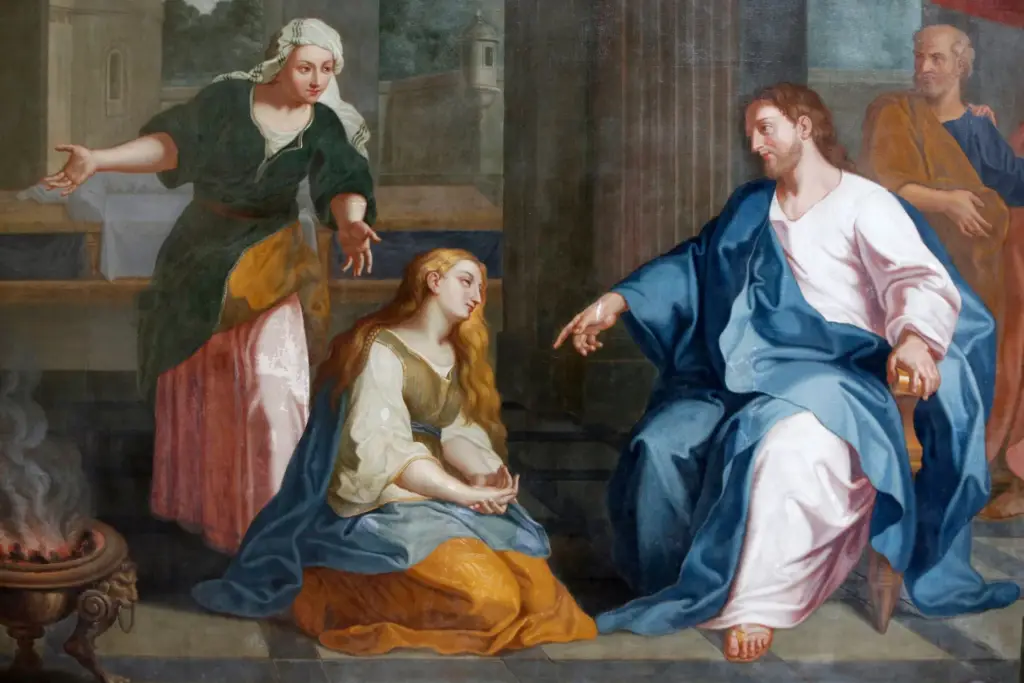
While Martha was busy serving, Mary sat down to listen to Jesus. When Martha protested, He replied:
“Martha, Martha, you are worried and upset about many things, but only one thing is needed—and Mary has chosen what is better.” — Luke 10:41–42
Mary understood that worship begins with listening. Before serving, speaking, or giving, we need to remain in the presence of Christ. She chose communion over activity.
Crying at his feet
When Lazarus died, Mary went to meet Jesus, fell at his feet and said, “Lord, if you had been here, my brother would not have died” (John 11:32).
Her faith was not free from pain or questions. Yet her suffering drew her toward Christ, not away from Him. Jesus did not reject her brokenness: He wept with her.
Worshipping at His feet
Six days before Passover, Mary took pure nard perfume, worth about a year’s wages, and anointed Jesus’ feet, drying them with her hair. The house was filled with the fragrance.
Judas protested: that perfume could have been sold and the money given to the poor. But Jesus defended Mary:
“Leave her alone; she has kept this for the day of my burial.” — John 12:7
Mary did more than express affection. She honored Jesus on the eve of his crucifixion and anticipated the preparation of his body for burial. While others resisted accepting that he would die, she worshipped him in the shadow of Calvary.
The meaning of the alabaster jar
Alabaster jars were used to store expensive perfumes and ointments. Maria’s jar contained pure spikenard, an imported and highly valuable fragrance. It possibly represented her inheritance, her savings, or her future security.
Mark recounts that the woman broke the jar and spilled the perfume (Mark 14:3). Once opened, its contents could not be recovered or saved for later. It was a complete and irreversible act of surrender.
Mary didn’t offer Jesus a small part. She poured it all out.
John adds that “the house was filled with the fragrance of the perfume” (John 12:3). The fragrance lingered in the air, on Jesus’ clothes, and on him. True worship also leaves a mark: it is born in the heart, but its influence extends to those around us.
What Mary teaches us about worship
Worship is a response to love.
Mary did not anoint Jesus to buy his favor. She did it because she had received his love, heard his Word, seen his tears, and witnessed the resurrection of Lazarus.
Worship is not a transaction or an attempt to convince God to love us. It is our response to the love we have already received.
“We love him because he first loved us.” — 1 John 4:19
Worship comes at a cost.
David declared: “I will not offer to the Lord my God burnt offerings that cost me nothing” (2 Samuel 24:24).
Mary’s worship cost her a fortune, her safety, and probably her reputation. Some called it a waste; Jesus called it a beautiful work.
The world values things by their usefulness and performance. Worship values them by the worth of the One who receives it. Mary didn’t calculate how much she could keep; she considered how much Christ was worth.
Worship is personal
Mary did not wait for the approval of those present. She recognized her Lord and acted. Her gesture was not a performance to impress others, but an intimate expression of love.
We can worship among thousands of people or alone in a room. What matters is not the setting, but a heart completely surrendered to God.
Worship sees what others do not see
Mary had listened to Jesus. She understood, at least partially, that his death was approaching and anointed him while she still could.
Worship is not just about singing. It means contemplating Christ, recognizing who He is, and responding to that revelation. Mary saw the Lamb of God and honored Him before His sacrifice.
The worship remains
Jesus affirmed that wherever the Gospel was proclaimed, what that woman had done would also be remembered (Mark 14:9).
Their worship continues to be part of the Gospel story. What we give to Christ may go unnoticed by the world, but it is never forgotten by God.
The Second Adorer
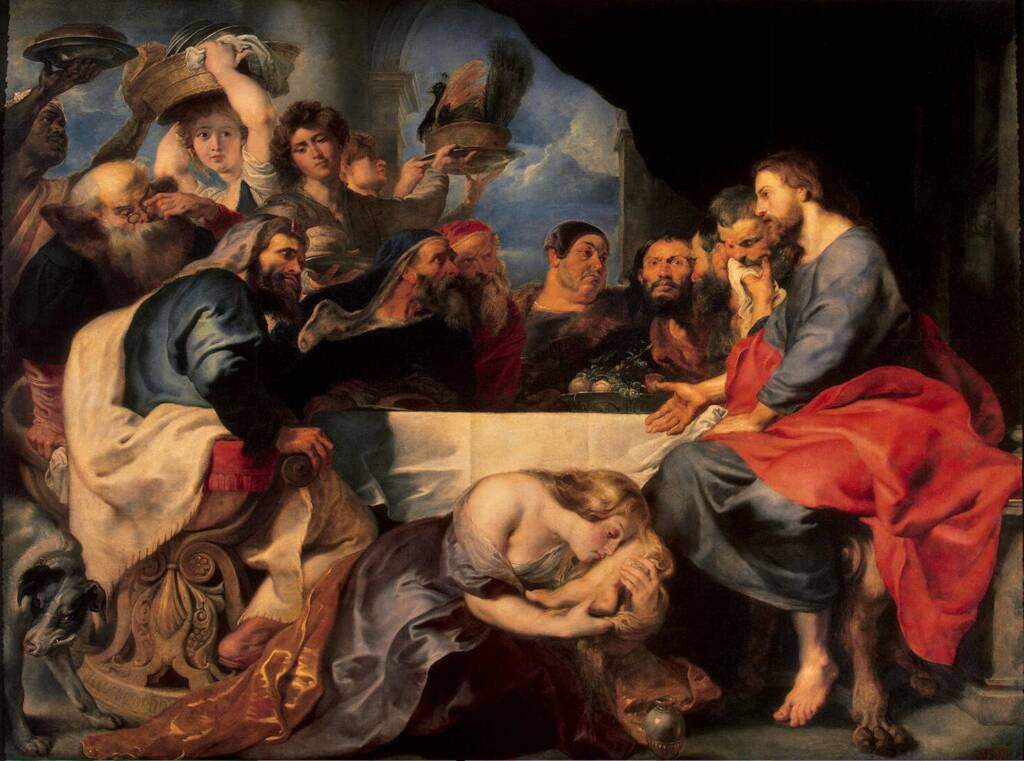
On another occasion, while Jesus was at the home of Simon the Pharisee, a sinful woman approached him, and touching Jesus’ feet, she wept at his feet and anointed them with perfume, then dried his feet with her hair. Luke 7:36-50 does not give the name of this woman.
The jar as an image of Christ
The alabaster jar also directs our gaze towards Jesus.
Just as the perfume was poured out, Christ willingly gave his life. Isaiah prophesied that He “poured out his life unto death” (Isaiah 53:12). Paul describes his sacrifice as “an offering and a sacrifice to God for a sweet-smelling aroma” (Ephesians 5:2).
Mary poured out her treasure upon Jesus; Jesus poured out his life for us. She did not withhold the perfume, and he held nothing back in his self-giving.
Sit down before serving
Many of us live like Martha: busy, distracted, and preoccupied with numerous tasks. Serving others is good, but it can never replace communion with Christ.
The order in Mary’s life is revealing:
- She sat at his feet to listen.
- She fell at his feet to cry.
- He anointed his feet to worship.
Before pouring out the perfume, she received His Word. Before offering her treasure, she knew His love. Worship is born from a heart that has first been filled by Christ.
Which is your alabaster jar?
We all possess something we cling to because it provides us with identity, control, or security. It might be our money, time, reputation, comfort, future, relationships, or talents.
The question is not whether we have an alabaster jar, but whether we are willing to place it at Jesus’ feet.
True worship can be costly and incomprehensible to others. It is opening our hands, relinquishing control, and surrendering to Christ what we value most because we recognize that He is worth far more.
When the bottle breaks, the house fills with fragrance.
Questions for reflection
- What is my alabaster jar: that which I most fear to give up?
- Am I too busy serving to sit at Jesus’ feet?
- Does my worship stem from love or from an attempt to gain God’s favor?
- What specific delivery could I make this week?
- What fragrance does my life leave in my home, church, and community?